
Truth, Responsibility, and the Future in a Reality of Ongoing Catastrophe
Between Dispossession and Erasure and the Building of Impact
Truth, Responsibility, and the Future in a Reality of Ongoing Catastrophe
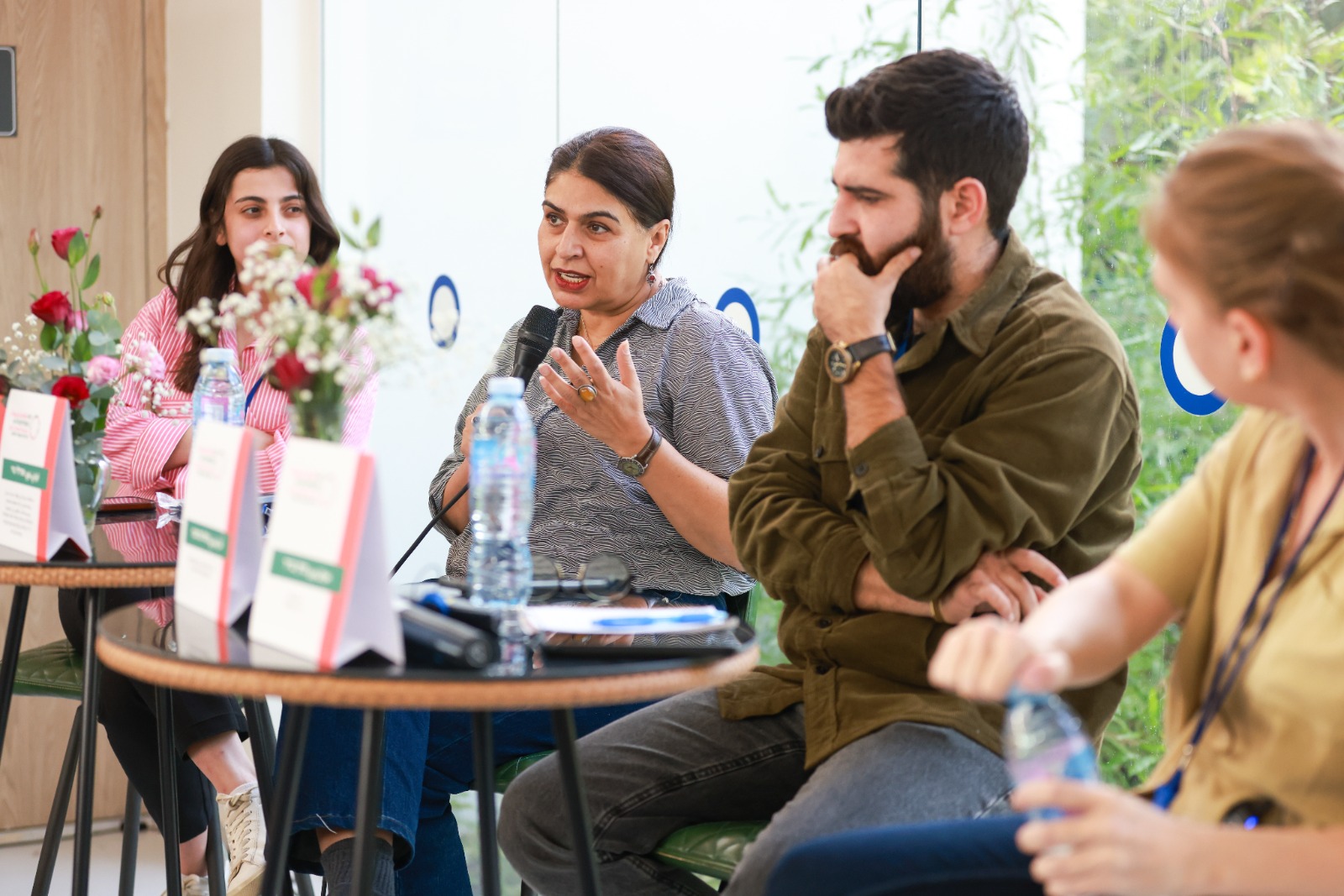
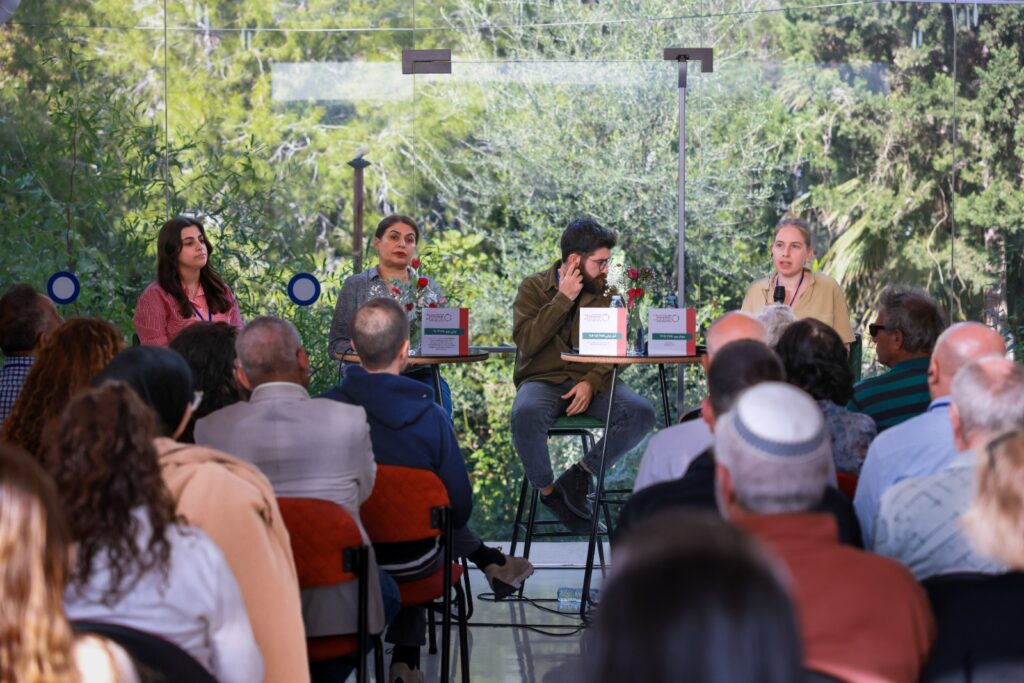
Amal Oraby and Orly Noy in a special panel at the School for Peace Alumni Conference
__
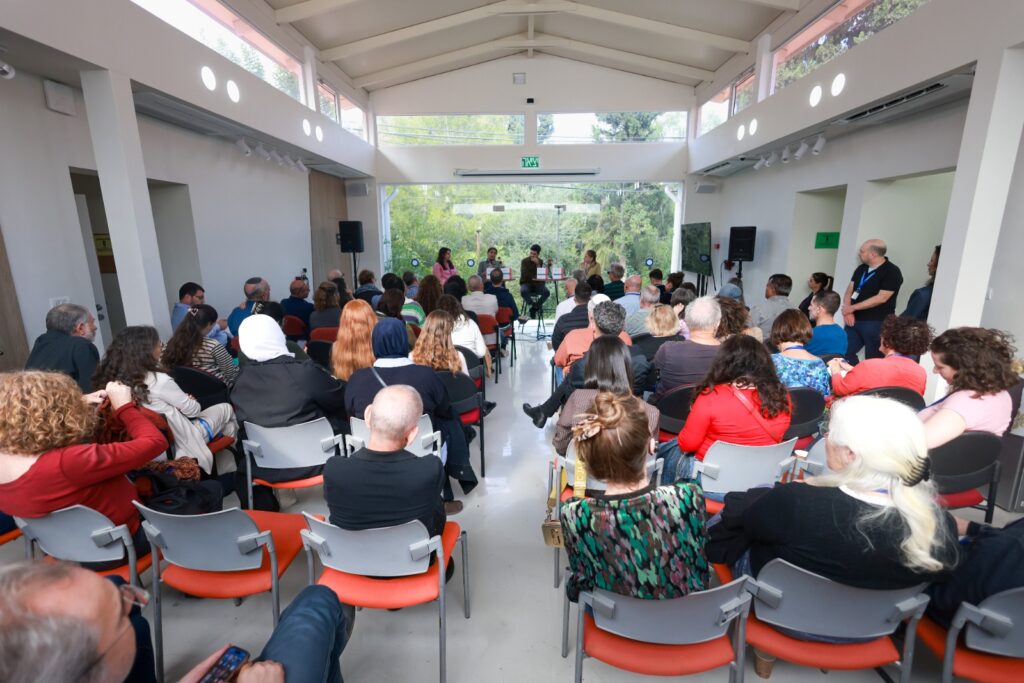
On December 5, we held a panel as part of the School for Peace’s annual alumni conference. The two-day conference serves as a space for personal and professional encounters among graduates of our various courses from all fields and all years. It aims for the exchange of knowledge, shared learning, deepening analysis of reality, and re-energizing toward continued action. At its center is an ongoing process of dialogue in fixed groups, combining binational and uninational dialogue facilitated by School for Peace facilitators and conducted through our unique dialogue method.
This year’s conference theme was: “Living in an Ongoing Catastrophe – Between Dispossession and Erasure and the Building of Impact.” We sought to examine together the tension between the physical and symbolic erasure that we experience and witness, and the possibility of acting within a reality of prolonged extreme violence, oppression and an ongoing trauma. At the same time, we asked how responsibility for the future can still be taken under such conditions. We aimed to create a space that looks at our lives, in which large and cruel forces dictate a reality of annihilatory war, destruction, and silencing. Within this space, we sought to open a conversation about our future – whether we have any control over it, and whether it is possible to influence what it will look like.
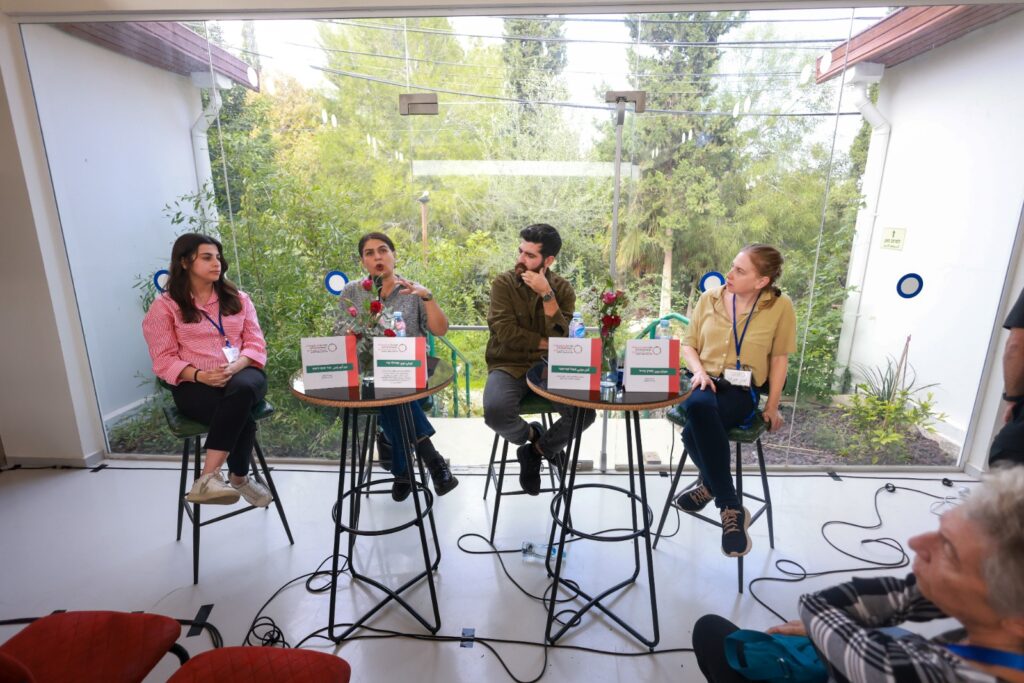
The panel, moderated by Noor Abo Ras and Moran Barir, took the form of a live conversation among facilitators, speakers, and participants – rather than a series of one-directional lectures. Speakers included Amal Oraby, a lawyer and human rights activist and a graduate of the School for Peace Change Agents course in the field of law, and Orly Noy, a journalist, editor, and translator. Inviting them was not incidental: our attempt to understand the implications of erasure and the possibilities for influence is grounded in dialogue between identities, and in the understanding that the Jewish–Palestinian encounter is, first and foremost, a political encounter between two national groups. We emphasize the question of each side’s role within existing power relations – what Jews and Palestinians can and cannot do from their respective positions. Both Amal and Orly publish work that offers analysis of reality from this identity-based perspective, giving it a distinct voice while also challenging their own collective as well as the other side.
What Has Changed in the Past Two Years?
The starting point for the discussion was the recognition that although we have been living through decades of ongoing catastrophe, in the past two years the catastrophe has reached enormous and unimaginable dimensions – and accordingly, so have its consequences for everyone.
Orly Noy described Israeli society as shaped by a complex interplay of continuity and rupture. On the one hand, she argued, the current reality is not incidental but the result of long-term processes; “we have arrived where we were headed,” she quoted Dov Alfon. Societies do not become genocidal because of a single trigger, even one as severe as October 7. It is an entire process that has led to the place we are in, and this is the dimension of continuity.
On the other hand, there is also a dimension of rupture: the Israeli ethos has undergone a shift. If until now Israeli society upheld the idea of liberal democracy – despite embedded racism and structural supremacy – this has changed. The ethos itself now includes violence, brutality, subjugation, and at times even annihilation. In effect, the gap between the society’s declared values and its everyday practices has narrowed, and with it, the space for repair has significantly diminished. It is difficult to confront society and call for justice when even lip service to ideas such as democracy and equality is absent. This places us in a different kind of reality – one that is far more dangerous.
And yet, it is important to note that even within this shrinking space, Orly insists on continuing to act and on not giving up on dialogue with Jewish society in Israel.
Amal Oraby described a deep destabilization of the sense of home. It is the result of a continuous attempt to convince him as a Palestinian that someone else is the landlord, and that the Palestinian home can, and even may, be destroyed, physically and metaphorically. From this emerges a sense of exile within one’s home, and even a double exile: both in the physical space and in the political one. He describes how his belief in the existence of laws and values that structure life has also been shaken; the language has changed, the rules have changed, and partners have shifted in what many describe as a ‘so-called awakening’*. Within this reality, moral standards have eroded to the point where, in his view, anyone who recognizes Palestinians as human beings and rejects indiscriminate killing can be seen as a partner.
* The ‘so-called awakening’ is a shift in which some Israelis who previously supported peace and Palestinian rights have moved toward more hardline positions, following the attack of October 7, 2023.
The Personal and Collective Role in Relation to Reality
The conversation moved to the question of role – on both the personal and collective levels – of Jews and Palestinians within their societies and outwardly.
Oraby cited a quote from Hannah Arendt stating that when we are lied to consistently, the lie does not become truth and the truth does not become a lie. What actually happens is that our orientation within reality – among other things through distinguishing between truth and falsehood – is undermined. From this, Amal emphasized the obligation to distinguish between truth and falsehood within a reality of manipulation and propaganda. To insist that truth exists – not everything is opinion and not everything is lies. It feels very lonely to stand alone with this truth, and perhaps it is not bad to be lonely in a reality entirely saturated with lies, manipulation, and annihilation. But the idea is not to embrace this loneliness, but to search for other such lonely people and create a shared home. Alongside this, he argued that Israel’s unprecedented brutal attack against the Palestinian people in all its parts aims to shatter Palestinians’ belief that they deserve to live with dignity and to reduce it to mere survival – from the uprooting of olive trees in the West Bank, through silencing and arrests within Israel, to annihilation in Gaza. In the face of this attempt at erasure, Amal contended that it is no longer enough merely to stand firm in the storm, which is the traditional Sumud, and proposed developing “positive Sumud,” which includes building societal infrastructure, looking toward the future out of the insistence that we do have a future, constructing a vision, and finding appropriate partners.
Orly Noy described a reality in which we are flooded and stunned by a torrent of evil – afraid, paralyzed, and silenced – aimed at producing a chilling effect. The response, in her view, is a conscious act of warming effect: to speak more, to insist on the political context that has become almost entirely forbidden to discuss after October 7, and to mark moral boundaries as public discourse drifts rightward. At the same time, she emphasized the need to recognize the limits of our influence at this moment – we did not succeed in stopping the genocide with our bodies; we had no such possibility. This is a soul-shattering yet necessary recognition. We must accept it in order to realize the other roles available to us.
We Hold a Political Responsibility, Not Only Moral
Oraby said he sees himself as an “expert on Jewish affairs” – in critical and humorous comparison to the many experts on Arab affairs sitting in Israeli TV studios and newsrooms – and from this position sought to address the role of Jews as well. He warned against narratives of “healing the rifts” common in Israeli society in the aftermath of wars and civil conflicts: a kind of ritual return to routine that erases Palestinians from consciousness. In contrast, he called for resisting the discourse of healing and instead for expanding the rift and exposing it to view.
Noy added that, alongside the role of speaking about the political context of events, another role arising now is the need to restore the discourse about apartheid, occupation, and oppression – to its political roots. In parts of left Jewish-Israeli discourse, Palestinian existence is confined to the humanitarian sphere alone – especially since October 7 and the genocide in Gaza. Within this conception, Palestinians are perceived mainly as victims, the occupation as the source of evil, and “the good Jews” as those who assist Palestinians from a moral stance. Yet when the victim is momentarily perceived as a perpetrator in the October 7 massacre, this paradigm cracks, and a sense of betrayal replaces compassion. From here arises a clear political responsibility: to insist that this is not merely a humanitarian case, but a political issue.
Oraby added that even declarations such as “not in my name,” “it’s not me, it’s the government,” or “the occupation corrupts us from within” miss the heart of the matter. Is it possible to continue being a good citizen of a criminal state? The story here is not how righteous you are on a personal level. Your citizenship is political – rise up, struggle, take political action. Do not retreat into yourself and cleanse your conscience with hollow statements.
Fear, Silencing, and Everyday Erasure
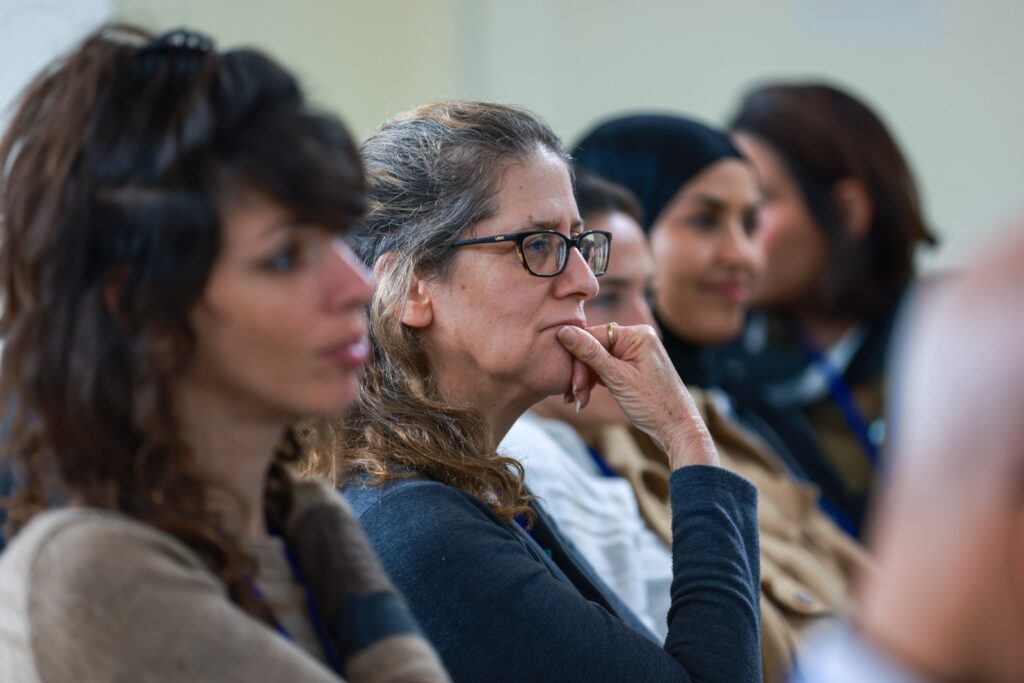
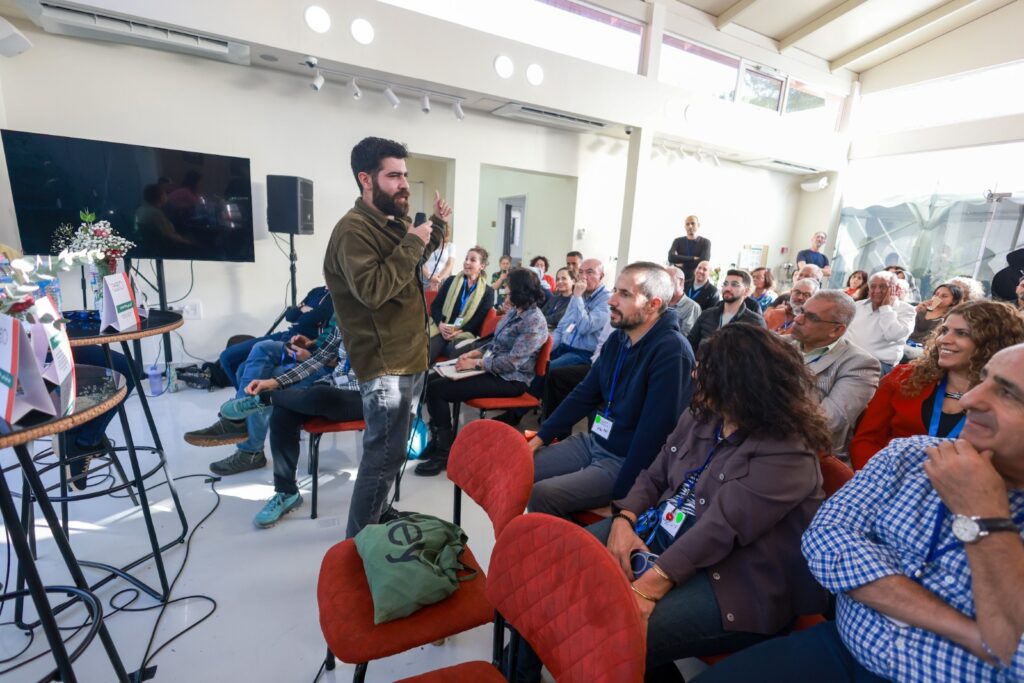
From the audience arose the issue of Jewish fear after October 7 – an existential fear with historical roots, yet also continually cultivated by the Israeli establishment. Noy pointed to the absurdity of a state that is a regional military power prioritizing its own emotional sensitivities while annihilating another people—a reality in which Jewish feelings take precedence over Palestinian lives. She gave as an example the Israeli police officer who killed Eyad al-Hallaq, a young unarmed Palestinian man with autism, and was acquitted in court after saying he shot because he feared for his life.
A Palestinian participant from the audience remarked that fear is an inherent component of Israeli identity, to the point of fearing the loss of the fear itself. Amal addressed the right to security and Jewish fears, and posed a principled question: whether it sees itself as a regional power or a perpetual victim. In the name of an eternal sense of victimhood – one that indeed has deep historical roots – can the killing of tens of thousands of children and the destruction of entire neighborhoods be justified? Is it acceptable that in the name of Jewish security, Palestinians are condemned to die or to continue living trapped behind checkpoints? According to him, the human dimension of historical pain is shared – “nothing human is foreign to us” – yet there is no humanity in dropping heavy bombs on a confined place.
Palestinian participants described living in a parallel reality of fear and silencing: living double lives in Jewish spaces, practicing self-erasure in order to survive, and facing conditions for dialogue that require prior identification with Israeli pain. One Palestinian participant shared that at times it is easier for her to identify with Israeli pain than to fully face Palestinian pain – because she truly fears that looking with open eyes at the reality in Gaza would not allow her to continue living normally.
__
Turbulence, Costs, and the Courage to Speak Truth
The discussion was at times stormy and highly charged, yet as Amal – our “expert on Jewish affairs” – reminded us with a quote from the Chazal (the Jewish sages), “a sword is sharpened by another sword”: there is value in the very encounter and speech, even when it involves disagreement and confrontation. Such a conversation enables all sides to understand themselves, their partners, and reality more deeply, and constitutes an act of resistance to the silence and silencing that have intensified over the past two years. From this also emerges shared inner strengthening and renewed discussion of principles, on the path toward forming a vision for a sane future.
At the same time, the very attempt to speak of the reality of ongoing and traumatic catastrophe is almost unbearable: it is difficult to be precise in words, to listen, to translate, and to be present – and at the same time silence is no less difficult. The emotional turbulence that arose is not marginal but an inseparable part of encountering painful truth and of the effort to understand and act for change.
It must also be remembered that speaking truth within a catastrophic reality, facing a power that seeks to distort and silence, entails a real personal cost. Orly and Amal shared the heavy prices they pay in their lives as a result of their work, reminding us that truth-telling requires courage, daring, and a willingness “to touch fire”; it is not always possible and never self-evident. Precisely for this reason, such an encounter holds deep and precious value – even when painful – and we thank all who chose to take part in it.
Speaking Truth and Creating a New Language
From the conversation emerged a central insight regarding the importance of speaking truth within a reality of lies, manipulation, and gaslighting. Its meaning is to insist that truth exists, to distinguish between the essential and the secondary, and not to relinquish moral boundaries even when the price is heavy.
But how do we speak truth when the words themselves have been eroded? How do we speak of crimes, pain, and an imagined future? Here another thought arises: the need to create a new language. A language not bound to collapsed theories or to words burdened with crimes; a language capable of containing pain, building partnership and vision, and opening the possibility of a future of life in dignity, security, and shared flourishing.
Perhaps this is one of the deepest tasks before us now – to create a language that not only describes reality, but makes it possible to change it.
__