
Between Despair and Responsibility: Inside the Dialogue Space
Between Despair and Responsibility: Inside the Dialogue Space
An analysis of the dialogue at the 4th Annual Alumni Conference of the School for Peace, December 2025
__
The Starting Point
The theme chosen for this year’s conference – “Living in an Ongoing Catastrophe: Between Dispossession and Erasure and the Building of Impact” – sought to bring an intimate and unfiltered perspective to the harsh reality of our lives. The premise was that the catastrophe is not a fleeting moment but an ongoing condition within which we live and act. The questions that were opened were not only “what are the catastrophes we are living through,” but also “how do we live within this,” “where do we have agency,” and “what does it mean to build impact when the very ground beneath our feet is unstable.”
Dialogue as Method
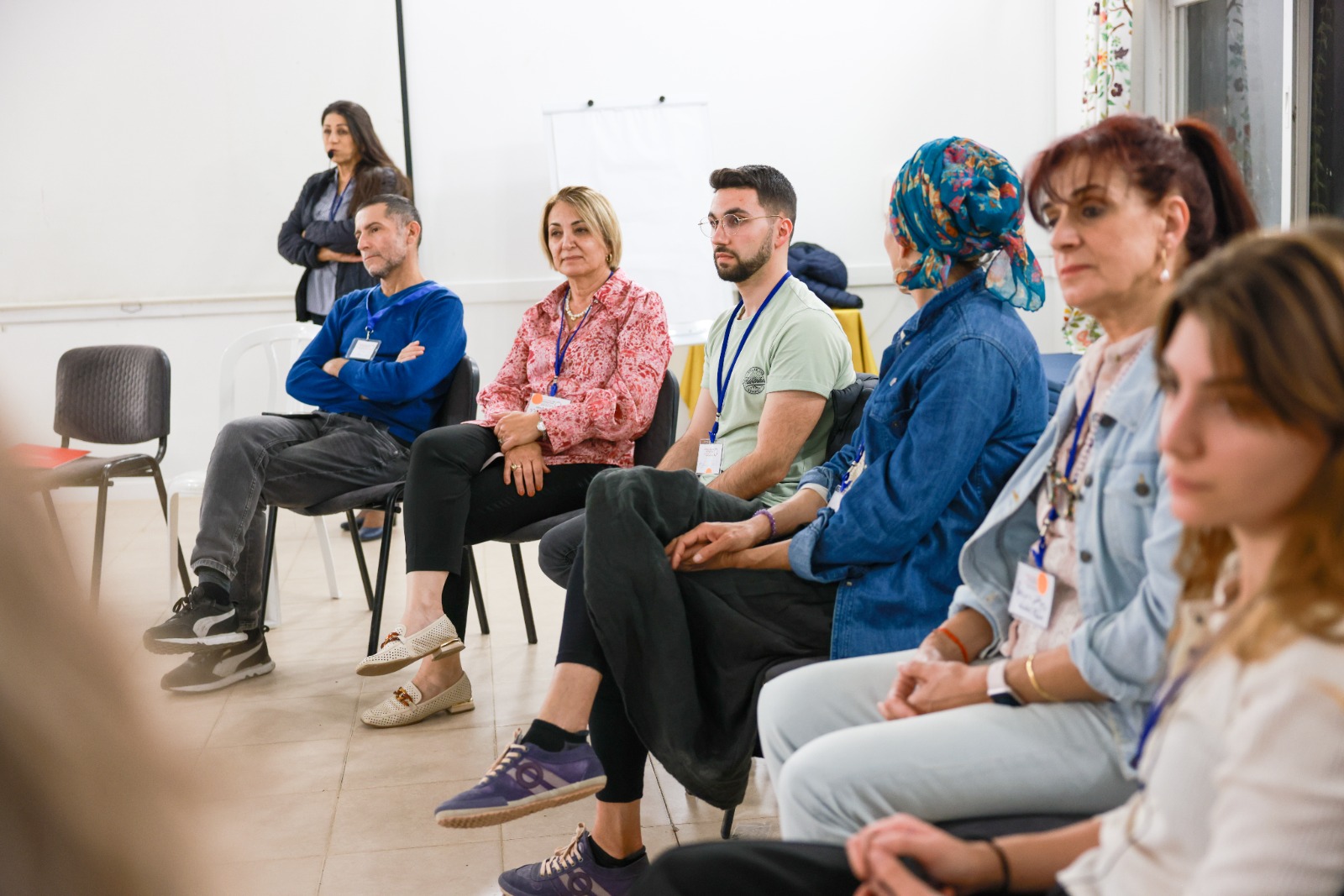
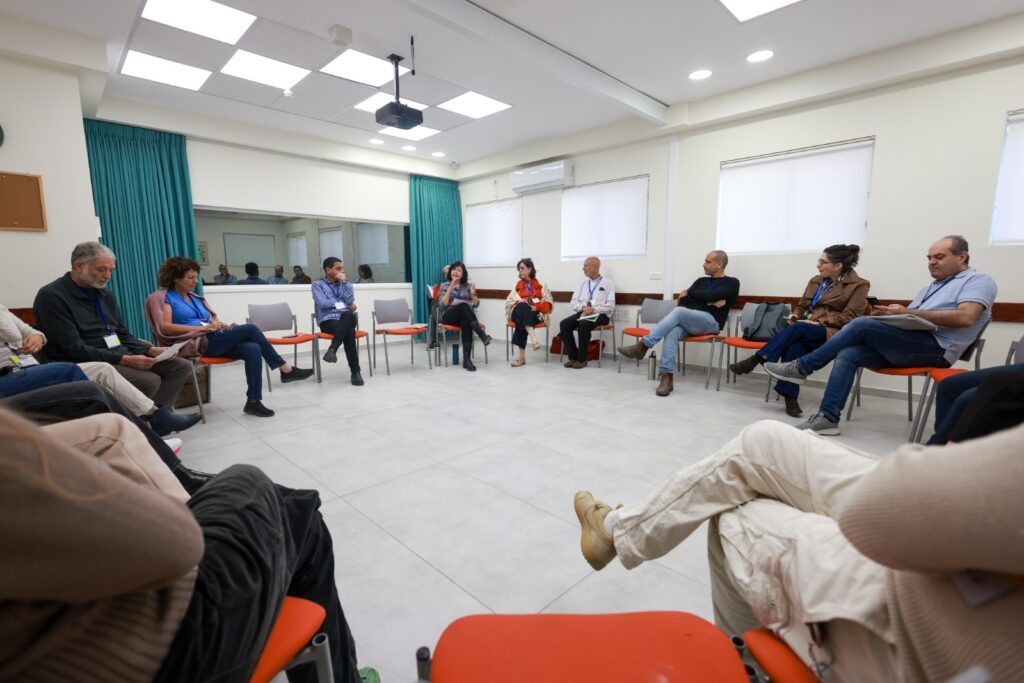
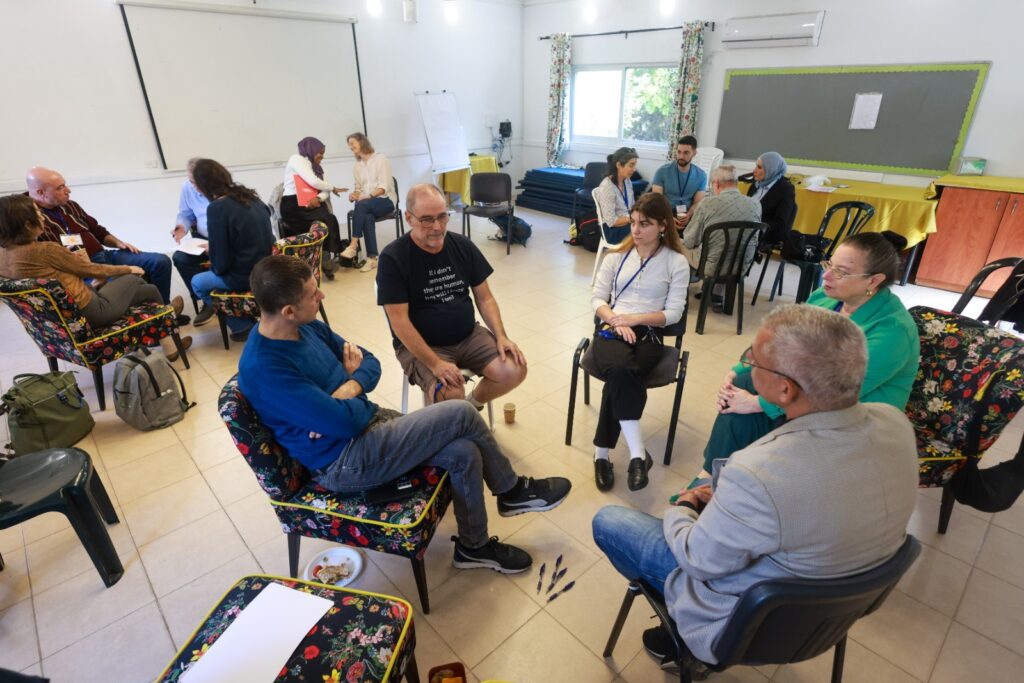
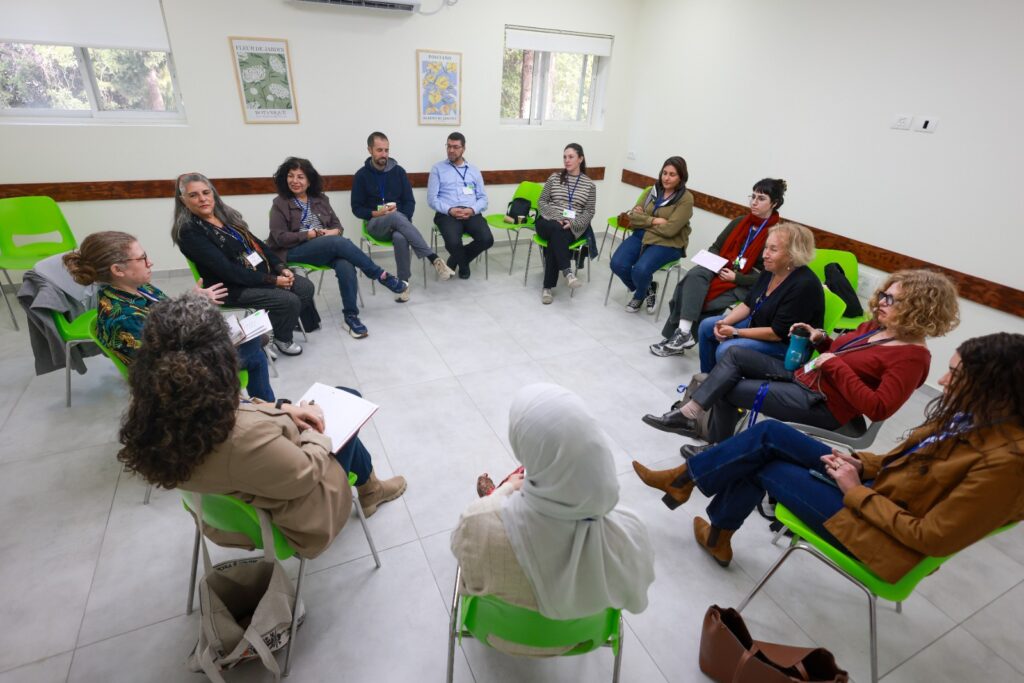
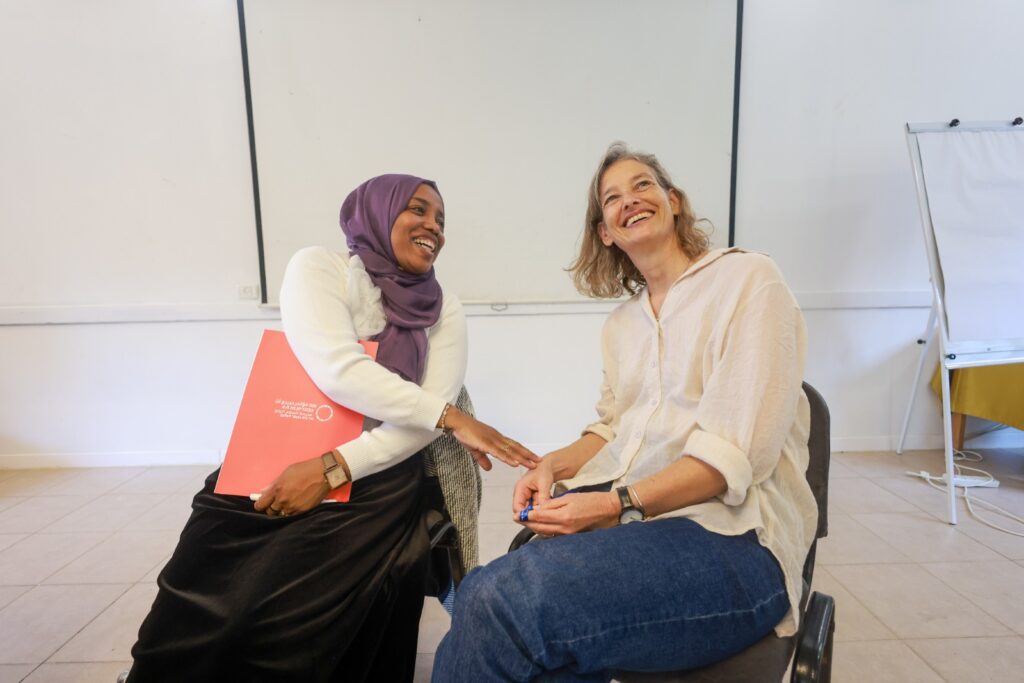
Dialogue – the central tool of the School for Peace – once again stood at the heart of the conference. Over the course of two days, five dialogue sessions took place in fixed groups, co-facilitated by a Palestinian facilitator and a Jewish facilitator, and conducted in a combination of Hebrew and Arabic with simultaneous translation. The movement between binational and uninational sessions allowed for a shift between speaking with and in the presence of the other, and turning inward, into one’s primary identity group.
Silence, Language, and Power
One of the central themes that emerged was the tension between silence and silencing. Participants spoke of years in which they had not fully expressed their positions, and noted that even now, as the space begins to open, speech remains cautious and hesitant, testing the limits of what can be said. The question arose whether this reflects external silencing – political and social – or an internal choice to remain silent, at times driven by exhaustion, fear, or a sense of helplessness in the face of the scale of reality. The dialogue itself mirrored this tension: circling around issues, choosing words with care, and at times avoiding deeper engagement.
In this context, the question of language took on particular significance. Beyond translation, language was perceived as a political tool and a site of power: some Palestinian participants felt a greater sense of safety when the other side did not understand their language, while some Jewish participants viewed learning Arabic as an act of responsibility and activism. The question of who speaks, in which language, and to whom became part of the dialogue itself.
Identity and Responsibility
Within the uninational spaces, deep questions of identity were opened. Among Palestinian participants, discussions focused extensively on the condition of Palestinian society in Israel – caught between social fragmentation, the erosion of collective identity, the absence of leadership and vision, and a desire to rebuild new frameworks of belonging. Alongside this, voices of despair emerged – including the sense that nothing can change the reality – yet also persistent efforts to ask what can still be done and what responsibility can be taken.
In the Jewish uninational space, different yet equally intense questions emerged: the relationship to Israeli identity – how connected one feels to it in these times, to what extent it is experienced as a burden or a source of shame, and how to reconstruct identity under such conditions and complex emotions. Participants spoke about the complexity of opposing the war and genocide when close family members are involved in it. The issues of military conscription and reserve duty, alongside the question of refusal, repeatedly surfaced as central themes in the Jewish group. Alongside these was a broader question – what constitutes meaningful political action in the current reality.
It was striking to observe that when Palestinians addressed the question of responsibility, they spoke in collective terms, asking what their responsibility is as a collective – for example, in building societal institutions, nurturing the next generation of leadership, and articulating a vision. When Jewish participants spoke about responsibility, they tended to frame it in individual terms – what do I, as an individual, do to resist injustice? The modes of taking responsibility thus took the form of personal activism: refusal, protective presence in the West Bank, and raising awareness among one’s community circles.
The binational encounter carried within it the tension between all these worlds. At times, there was closeness and mutual curiosity; at others, distance and even refusal to engage in binational dialogue, especially following charged uninational sessions. And yet, there were also moments in which the very fact of being together enabled an exploration of identity in the presence of the other – how do I define myself when the other is listening, challenging, or simply present.
Another recurring theme was the engagement with terms and political language – particularly the question of using words such as “genocide.” For some participants, the debate over terminology was perceived as a distraction from reality itself, while for others it was a struggle over definition, recognition, and meaning. The disagreements around language were not resolved, but they revealed the depth of the gaps and the importance participants attribute to how reality is described.
Alongside all this, there were also attempts to think about action: proposals for joint initiatives, ideas for impact through education, media, or community-based activity. Yet here, too, a dual movement often appeared – between a desire to act and a sense of inability, between initiative and doubt. It seemed that the very act of raising ideas was no less meaningful than their implementation, as part of a process of searching for possibility within a closed reality.
Possibility, Limits, and Why We Are Here
Amid all this complexity, a simple yet profound question also emerged: why are we here? For some, the answer was the encounter itself – the possibility of being in a space where honest speaking is encouraged, even without agreement; where listening is practiced, even when it is challenging; and where it is possible to remain together within uncertainty. For others, the question remained open, perhaps even sharpened: is this kind of dialogue capable of generating change, or does it merely reflect the limits of what is possible and the constraints of reality?
The conference panel called for insisting on speaking truth and for searching for a new language within a reality where words are worn down. The dialogue at the conference revealed just how essential – and how difficult – this task is. Again and again, it became clear that the struggle is not only over what is said, but over the very ability to speak. The dialogue became a living laboratory for that very question: how do we create language when the words themselves are charged, contested, or experienced as insufficient in the face of reality?
And within this tension, perhaps a direction also emerges. Not as a complete and coherent language that already exists, but as a process of groping forward: attempts, mistakes, silences, collisions, and moments of understanding. Moments in which a partial truth is spoken, even if cautiously; in which complexity can be held, even if not resolved; in which an initial possibility of seeing and being heard is formed. In this sense, dialogue is not only a space that enacts the call to create a new language, but also one that tests its limits – how far truth can be spoken, and what conditions are required for a language to emerge. A language that can not only describe the ongoing catastrophe, but also open cracks within it for change.
__