
Mental Health as a Site of Peacebuilding | Article
An article on The School for Peace’s Work in the Field of Mental Health
I. Introduction
A Reality of Crisis and Psychological Instability
The unending and escalating cycles of violence in Israel and Palestine have created a widespread and persistent mental health crisis. The latest round of destruction in Gaza—described by legal and human rights experts as genocide, due to targeted starvation, the widespread killing of children, and the total destruction of infrastructure—has unleashed an unprecedented mental health crisis across all sectors of Palestinian and Israeli societies.
While the physical devastation is centered in Gaza, the psychological impact extends far beyond. Among Palestinian within Israel, the war has triggered deep emotional distress, marked by fear, social isolation, and political repression of free speech. Reports document rising anxiety among Palestinians who fear surveillance, professional retaliation, or criminalization for expressing solidarity with civilians in Gaza. Students and professionals have been suspended, dismissed, or interrogated for social media posts deemed politically unacceptable — contributing to a climate of anticipatory trauma and racialized stress.
On the Israeli side, the October 7th Hamas attack and its aftermath have triggered a parallel surge in trauma, displacement, and existential fear, especially among survivors, evacuees, and the families of hostages. According to Israel’s Ministry of Health, demand for psychological support rose by over 300% in the weeks following the attack, with children exhibiting acute stress symptoms and schools struggling to cope. Psychologists have warned that Israel’s health system is ill equipped to meet the needs of individuals or what research has characterized as “national trauma.” Israeli society is contending with the emotional toll of prolonged conflict, the ongoing hostage crisis, and the deepening moral distress surrounding the war’s consequences, including the moral injury and posttrauma experienced both individually and collectively by those taking part in the violence in Gaza.
II. Mental Health in Peace and Dialogue Work
Responding to Evolving Needs: the SFP Method and the Limits of Classical Psychology
At the School for Peace, we have witnessed the emotional toll of first October 7th, and then the genocide in Gaza across over 200 dialogue sessions, where both Palestinian and Jewish participants struggled to remain present in an environment of deepening fear and polarization. From the outset of the conflict, many Palestinian participants have reported feeling silenced — entering spaces where political repression outside the group echoed within, making it unsafe to express grief or dissent. As facilitators have noted, this created a painful paradox: Palestinians are invited into dialogue by institutions or workplaces, only to find that the very conditions of the dialogue muted their voices, by not allowing them to express their views on Israel or what is happening in Gaza. Simultaneously, many Jewish participants, reeling from existential shock, demanded explicit condemnation of the October 7 attacks from their Palestinian peers. This dynamic, rooted in a desire to feel safety and control, has revealed sharp asymmetries in power and whose and what emotions are allowed to be expressed.
In the field of mental health, ongoing and growing instability has been shown to cause emotional exhaustion and professional burnout. Mental health practitioners and healthcare workers, who often hold space for others’ pain, are themselves operating under immense stress, moral injury, and ethical dilemmas related to their role in politically charged contexts. The School for Peace aims to train these practitioners in critical approaches, as well as to develop with them new professional approaches that directly address the impact of the political reality in Palestine-Israel on mental health practitioners and the communities they work with.
From its inception, the School for Peace approached dialogue work with a critical stance toward classical psychological models, particularly those rooted in Western, individual-centered paradigms. As early as 2000, in the School for Peace’s foundational book on its dialogue method, Ramzi Suleiman articulated this critique clearly, arguing that while such frameworks offer valuable tools for understanding personal and interpersonal dynamics, they often fail to address collective narratives, structural violence, and asymmetrical power — all central to the political realities of the Israeli-Palestinian conflict.
This insight became a cornerstone of our methodology, guiding the development of an approach that centers group identity, historical narratives, and power asymmetries. In our work with mental health practitioners, many often cite a lack of psycho-political understanding in mental health services. For example, a participant in our learning and development group shared the impact of treating trauma in a well-known and respected Israeli mental health institution which sits atop a destroyed Palestinian village that was the site of an infamous massacre in 1948. The fact that this center operates without publicly acknowledging that history, is a stark example of how structural erasure and unprocessed collective trauma can be reproduced in mental health settings.
Another participant spoke of a severe lack of political awareness in professional supervision, a cornerstone of psychological professionalism and care. She described how supervision often remains insulated from these political and historical realities. Others shared similar experiences, of supervisors that emphasize clinical neutrality or personal countertransference, while ignoring the power dynamics, colonial histories, or national traumas that shape both patient experiences and practitioner subjectivities. In doing so, participants recognized how supervision reinforces depoliticized models of care that leave practitioners unequipped to recognize the deep ethical tensions they navigate in their work, particularly in settings marked by systemic inequality and historical violence.
It is in this urgent and painful context that the School for Peace has deepened its collaboration with mental health professionals. We view this work as a contribution toward integrating group and intergroup perspectives into the field of mental health—recognizing not only the individual but also the political and relational contexts that shape psychological well-being at the group level. By doing so, we believe it can improve both mental health practices and as a result, contribute to a more just political reality. In societies saturated with fear, denial, and systemic oppression, addressing emotional reality is a precondition for justice and reconciliation. Healing trauma is a political act, one that enables individuals and communities to imagine a future free of violence and to take concrete steps towards it.
Mental Health as a Political Tool
Disconnecting mental health from political realities only serves to reinforce current hegemonic power structures. At the School for Peace, we view psychological well-being not only as a personal issue but as a reflection of structural violence and power relations. Trauma here is collective and ongoing — shaped by occupation, racism, fear, and historical injustice. Addressing mental health, then, becomes essential to any vision of peace.
Furthermore, mental health is not only political, but psychological and psychoanalytic concepts can also play a role in making sense of political realities. As psychiatrist and trauma scholar Vamik Volkan has noted, trauma is not only personal but relational. Collective trauma, he argues — especially when unprocessed — becomes embedded in national identity and intergroup perceptions, which can lead to ethnic violence. Sociologist Amalia Saar has employed Julia Kristeva’s psychoanalytic theory of “abjection” – the state of being revolted by something that threatens the boundaries between self and other – to explain the widespread dehumanization of Gazans in mainstream Israeli society.
Many Palestinian participants in our programs are also experiencing what has been termed racial trauma — a concept that captures the psychological impact of chronic exposure to systemic oppression, discrimination, and political silencing. Jewish participants, particularly after October 7, grapple with existential fear and moral distress. These emotional responses are not isolated; they stem from deep societal fractures and historical narratives of victimhood, abandonment, and survival. Intergenerational trauma for both Palestinians and Jewish Israelis plays a significant role in shaping these emotional landscapes: for Palestinians, the Nakba is not only a historical event but a lived, ongoing experience of dispossession, exile, and erasure that continues to inform identity and psychological vulnerability across generations. Similarly, the Holocaust has left a lasting imprint on Jewish collective memory, often manifesting as a fear of annihilation and hypervigilance in times of crisis, traits which have been linked to right-wing extremism.
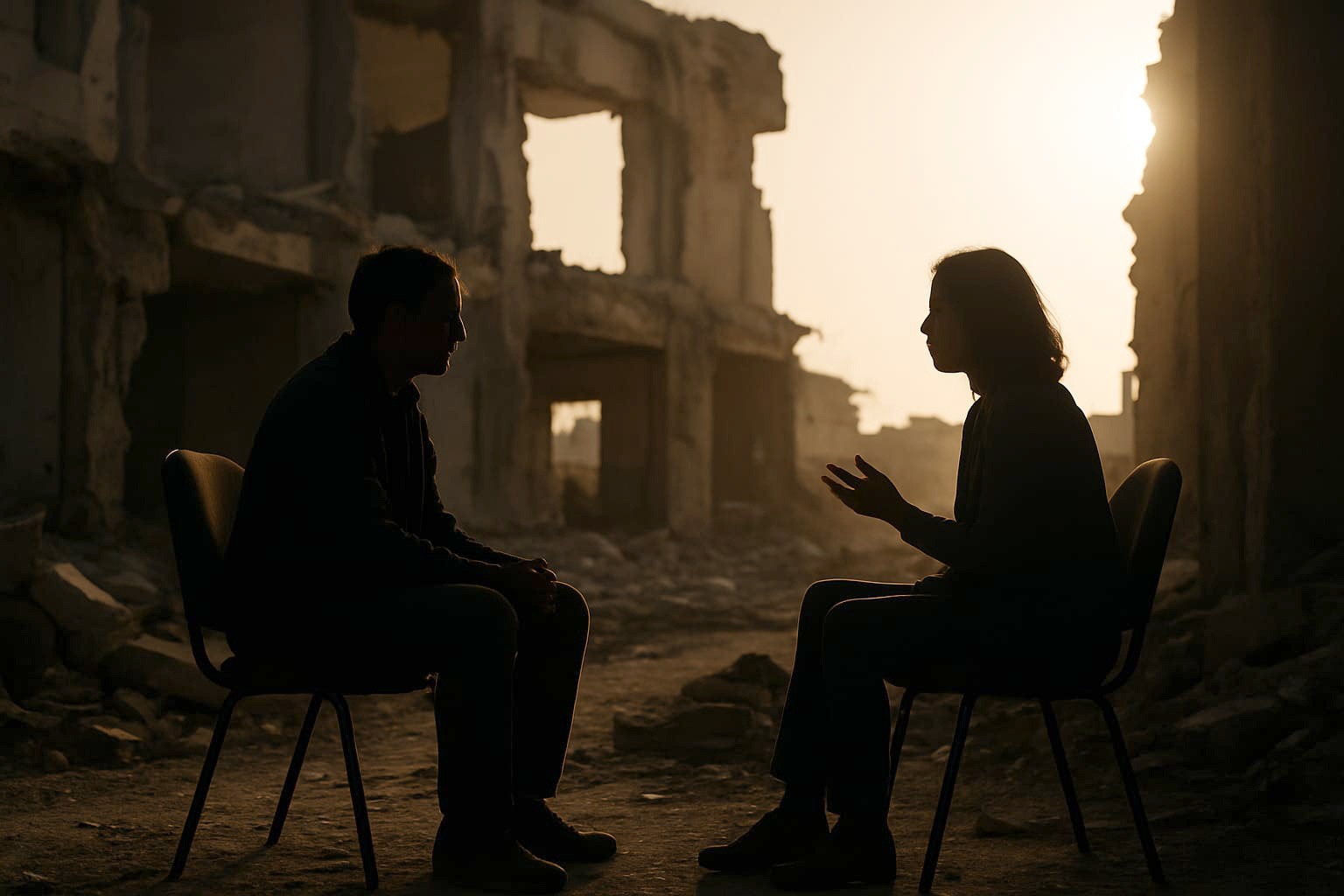
With regards to our work, D.W. Winnicott’s theory of the “potential space” — an intermediate realm between internal and external realities — has proved to be a helpful frame for the unique importance of dialogue in the moments of collapse we are currently experiencing. In dialogue sessions at the School for Peace since October 7, the Jewish group has often sought to reclaim control through moral clarity – by insisting that Israel’s response to October 7 is justified and demanding Palestinian participants condemn the attack – while, as they are exposed to the genocide and exceedingly dire humanitarian crisis in Gaza, Palestinians have tended to express a hopeful desire for mutual recognition and a safe space that would hold their pain without demanding loyalty tests. The tension between these unmet emotional needs threatens to fracture groups, but also highlights the critical role of the dialogue space as one of the few remaining arenas where complexity and vulnerability can be held. This fragile potential space, built on ethical facilitation and trust, offered participants a rare opportunity to process trauma not in isolation, but relationally — within the very rupture lines that defined their conflict.
Mental Health and Dialogue
Our work draws on liberation psychology, developed by Ignacio Martín-Baró, which emphasizes that healing requires naming the social roots of suffering. This approach moves beyond diagnosing symptoms to fostering critical awareness and collective agency. Dialogue becomes a therapeutic act — a space to reclaim voice, resist silencing, and shift power.
Therapists, in this context, are not neutral actors. They are potential change agents. When engaged in structured dialogue and reflection, they help participants process moral injury, explore intergenerational trauma, and develop tools for resilience. This is particularly true in bi-national settings, which creates what critical social work scholars Nadera Shalhoub-Kevorkian and Dorit Streir call a context-informed, counter-hegemonic approach. This approach foregrounds joint analysis of the politics of knowledge production, insisting that mental health work and research in colonial or asymmetric contexts must not only document suffering, but also interrogate the structures that produce it.
In our programs, mental health professionals become bridges between communities. They support clients in navigating identity conflicts and ethical dilemmas, while also reflecting on their own political and emotional positioning. This dual role — as healer and witness — makes them key actors in building a just society.
Ultimately, we believe that addressing mental health and practitioners are not separate from peacebuilding. Rather, they are central to peace and justice work. In times of war and repression, creating space for emotional truth and psychological resilience with practitioners is a radical act — one that can open the door to justice, recognition, and shared humanity in communities and individuals far beyond our participants.
III. What We Are Doing: Three Current Initiatives
- Mental Health Alumni Forum
The Alumni Forum brings together graduates of our mental health courses for ongoing dialogue, peer support, and shared political reflection. These meetings allow professionals to deepen their engagement with questions of identity, ethics, and power, especially during times of national crisis. Thus far, we have held two lectures for alumni, and we plan to continue holding semi-regular gatherings over the coming months. The forum strengthens a network of practitioners committed to navigating the psychological impact of the conflict on both clients and therapists. It provides a space to examine how therapists’ professional responsibilities intersect with their national, cultural, and political identities — especially as public discourse becomes even more ultranationalist and repressive. - “Agents of Change” Course for Mental Health Professionals
This flagship program trains Palestinian and Jewish therapists in the principles of dialogical work and socio-political analysis. Through uni-national and bi-national sessions, participants explore group identity, historical narratives, and the power dynamics embedded in therapeutic settings. The course integrates theory, practice, and activism, empowering participants to become agents of change in their communities and professional environments. Topics include liberation psychology, structural violence, collective trauma, and ethics in politically charged contexts. Graduates will go on to build social initiatives, lead workshops, and influence public discourse on mental health and justice. - Learning and Development Group: “Psycho-Politics in Therapy”
The ongoing war and unprecedented destruction are shrinking not only the public space for critical dialogue but also the therapeutic space. Settings meant to hold pain, complexity, and ambiguity have become fragile and affected themselves. The therapeutic space, often perceived in Western psychology as neutral, safe, and universally accessible, is revealed to be deeply influenced by political and cultural context. In a reality where the basic rights such as access to food and water are under assault, it becomes increasingly difficult to maintain a reflective space that allows for inner exploration and honest dialogue. In response, a new group initiated by the School for Peace and the Ma’ana Center – Nazareth Hospital brings together Palestinian and Jewish therapists to examine how political realities shape therapeutic roles and to explore the creation of treatment spaces that confront oppression with honesty, ethics, and depth.
IV. Conclusion
In moments of collective trauma and societal collapse, mental health work must rise to meet the complexity of the political and emotional landscapes it inhabits. The School for Peace’s engagement with mental health professionals is not an auxiliary effort but a necessary evolution of peace and justice building itself. When entire communities are engulfed in fear, grief, and moral injury, the ability to hold space for healing becomes a radical act of resistance, an act that Palestinian and Jewish practitioners in Israel are not trained to perform. Therapeutic spaces can no longer be imagined as neutral sanctuaries detached from the conditions around them – they must instead become sites of ethical engagement, where psychological care and political awareness coexist. Our work insists that therapeutic intervention can and must respond to the structural forces that wound individuals and societies alike.
Through programs like the Alumni Forum, the “Agents of Change” course, and the learning group on psycho-politics, we are aiming to implement and build models in which mental health practitioners can serve as both witnesses to trauma and agents of justice. In these spaces, Palestinian and Jewish professionals confront the intergenerational legacies of violence, the asymmetries of fear and power, and the urgent need to build frameworks of care that acknowledge historical and ongoing injustice not only at the individual level but at the group and societal levels. These initiatives create opportunities for the co-creation of knowledge that does not erase differences or power imbalances but rather engages them with empathy and accountability.
–