
Facing Turbulent Winds | Article
Facing Turbulent Winds
Insights from a facilitated dialogue Process with the Teaching Staff of a Binational Palestinian-Jewish School
Michal Zak, Rose Amer, and Roi Silberberg
This article presents insights from a facilitation process conducted with the teaching staff of a Jewish-Arab binational elementary school in Israel during a period of war, from October 2023 through May 2025. The group was co-facilitated by a Palestinian facilitator and a Jewish facilitator. The aim of the facilitation was to hold the group together while developing a shared educational language capable of addressing national, cultural, and personal differences. The article examines the challenges the facilitators faced – coping with silence, fear, and distrust – and the methods they employed in order to enable reflective pedagogical-political dialogue during a time of crisis. It also describes a range of methods such as facilitated dialogue, uninational groups, analogical learning, and the use of artistic space designed to sustain the group without silencing the conflict. The approach draws on the foundational assumptions of the School for Peace and on principles of critical pedagogy. The article offers insight regarding facilitation during wartime, the challenges of sustaining a mixed staff within an unequal reality, and of developing a pedagogy that seeks not only to survive, but also to reflect and transform.
Keywords: group facilitation, peace education, binationality, collective identity, educational staff, teacher professional development, dialogue during wartime, School for Peace
Michal Zak, facilitator at the School for Peace in Neve Shalom/Wahat al-Salam, political educator and activist specializing in work with educational teams in situations of conflict.
Rose Amer, facilitator at the School for Peace in Neve Shalom/Wahat al-Salam, educator and activist with extensive experience accompanying Jewish-Palestinian teams in shared schools.
Roi Silberberg, director of the School for Peace in Neve Shalom/Wahat al-Salam, activist in peace education and dialogue between identity groups, and developer of training programs for educational teams in Israel and the occupied Palestinian territories.
We thank the participants in the group for the opportunity to go through this extraordinarily difficult period together. The openness, clarity, and perseverance of the teachers were a source of support for us.
Introduction
A few days after October 7, 2023, the group facilitators met via Zoom with the teaching staff of a binational Palestinian – Jewish elementary school as part of preparations for returning to the classroom. The meeting was intended to provide the staff with a space for sharing, expressing pain, and acquiring tools that would help them understand the situation ahead of meeting with students again. The atmosphere in the country was harsh, and the word “trauma” had become commonplace in Israeli society. In the workplace and in the media Jews repeatedly demanded to hear Palestinians’ unequivocal condemnation of the Hamas attack.
The facilitators asked the Palestinian school principal to open the meeting with a few words reminding everyone of the school’s vision, which advocates an atmosphere of mutual respect and equality, humanistic dialogue within a binational framework, and education for shared life. The facilitators invited staff members to share how they were doing, their feelings and thoughts, and clarified that time would also be allocated for pedagogical preparations for returning to school.
The first to speak were Jewish men, and the phrase repeated again and again was “helplessness.” They were followed by Jewish women who shared feelings of distress, fear, anxiety, panic, and concern for family members serving in the army. The Palestinian teachers remained silent.
After approximately twenty minutes, the facilitators turned to the Palestinian teachers and said that it was understandable that they were not speaking, and that there was no obligation to share. At the same time, if any of them wished to explain their silence, this would be the appropriate moment to do so before moving to the pedagogical portion of the meeting.
One after another, the Palestinian teachers explained that they were afraid to walk in public wearing a hijab or speaking Arabic. They described how many Palestinian citizens were being summoned for police questioning or disciplinary hearings at their workplaces, including the board of education, with some even suspended from work. They spoke about the intense sense of surveillance and persecution they were experiencing – to the extent that they did not dare even to “like” a Facebook post expressing solidarity with Palestinian suffering.
The Jewish teachers said they had not been aware of this reality and admitted that they had interpreted the Palestinians’ silence as support for the Hamas attack. Toward the end of the meeting, as discussion turned toward returning to the classroom, teachers shared their dilemmas.
A relatively new Jewish teacher expressed concern that she might feel overwhelmed and break down emotionally in class. Other teachers wondered how they should respond both to expressions of support for the Hamas attack and to expressions of support for the Israeli assault on Gaza.
The issue of flags also arose. During the period of online learning, students had drawn Palestinian or Israeli flags, provoking strong emotional reactions among both students and teachers. We invited the more veteran teachers to share from their considerable experience during previous periods of tension, especially the events of May 2021, when tensions between Jews and Palestinians within Israel were particularly high. The veteran teachers offered practical recommendations and shared practices and tools that had proven effective in the past, thereby reassuring the younger teachers.
All of the above encapsulates the complexity inherent in dialogical work within an educational institution committed to Jewish-Arab partnership, during a prolonged war.
This article presents insights from a facilitation process conducted with a teaching staff at a Jewish-Palestinian school in Israel during two years of war. The meetings took place as part of a professional training facilitated jointly by a Jewish facilitator and a Palestinian facilitator. The purpose was to develop tools for coping with national, cultural, and pedagogical disagreements and to strengthen the school’s professional partnership, which at times seemed on the verge of disintegration.
The article was written by the facilitators of the training program together with the director of the School for Peace, who accompanied the process and served as liaison between the facilitators and the principal of the bilingual elementary school that requested the training.
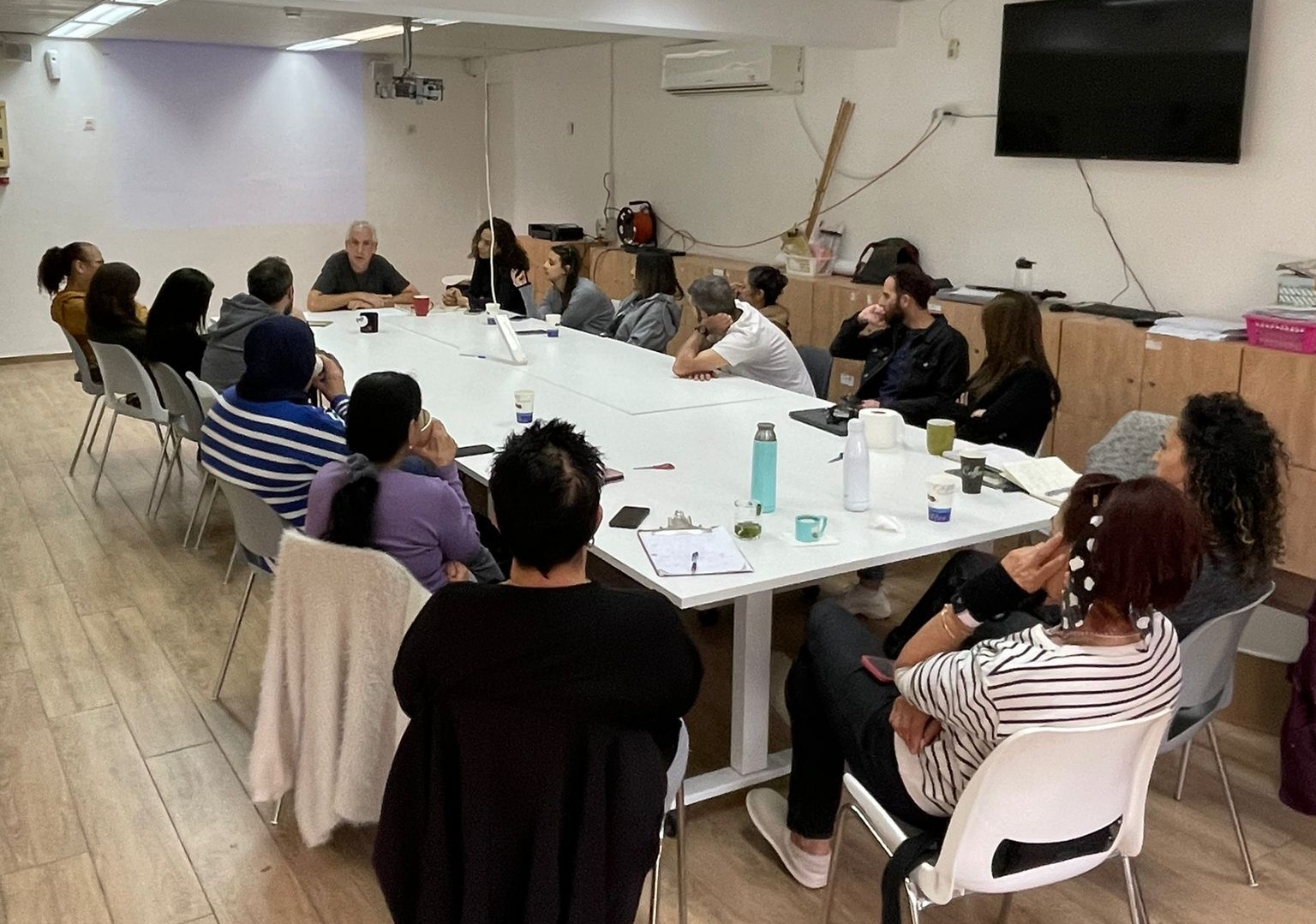
The group was grounded in many years of shared work, commitment, and friendship among staff members. The training had begun approximately one year before the war, but the first year of the war – and even more so the second – required an exceptional response to the challenges that emerged. The facilitators grappled with how to sustain a Jewish-Palestinian space at a moment when the deep rupture between the two peoples had surfaced so painfully and unmistakably. They struggled with the question of how dialogue could be sustained when the teachers were living such radically different realities, consuming entirely different media, and undergoing profoundly different experiences both in their lives and within the school.
Disagreements that had previously existed became almost unbearable. At the outset of the war, the teachers arrived at the training vulnerable, frightened, threatened, and at times alienated from one another. The task was to conduct a meaningful training process without dismantling the group, yet also without silencing the conflicts.
The article is based on meeting summaries and conversations held throughout the two years among the facilitation team, as well as on insights that emerged from this process. Throughout the article, we employ concepts and terminology drawn from the field of Jewish-Arab dialogue.
About the Group and Its Context
The elementary school in which the training took place is a public school with a staff of approximately twenty teachers, mostly women, about half of them Jewish and half of them Palestinian, all Israeli citizens. Most are veteran teachers who have known one another for many years.
This is a stable and highly professional team that sustains an extraordinary professional partnership on a daily basis. Most staff members work at the school out of choice and deep commitment to its vision. Over the years, the team adopted practices of shared work aimed at increasing the visibility of the Arabic language, developing cultural sensitivity, recognizing historical narratives, and creating a unique calendar marking national days significant to both Israeli Jews and Palestinians (all of the above do not exist in other public schools in Israel, which are either Jewish or Palestinian). All of this takes place within a reality in which relations between Palestinians and the Jewish state are neither equal nor just, and where everyday life contains profound complexities: diverse and at times conflicting political positions, differing levels of political awareness, and differing willingness to engage in conflictual dialogue.
The training program took place over three years, the last two during wartime. Participation was recognized for professional development credit but was not mandatory. Nevertheless, nearly all staff members chose to participate as part of an ongoing process of team development.
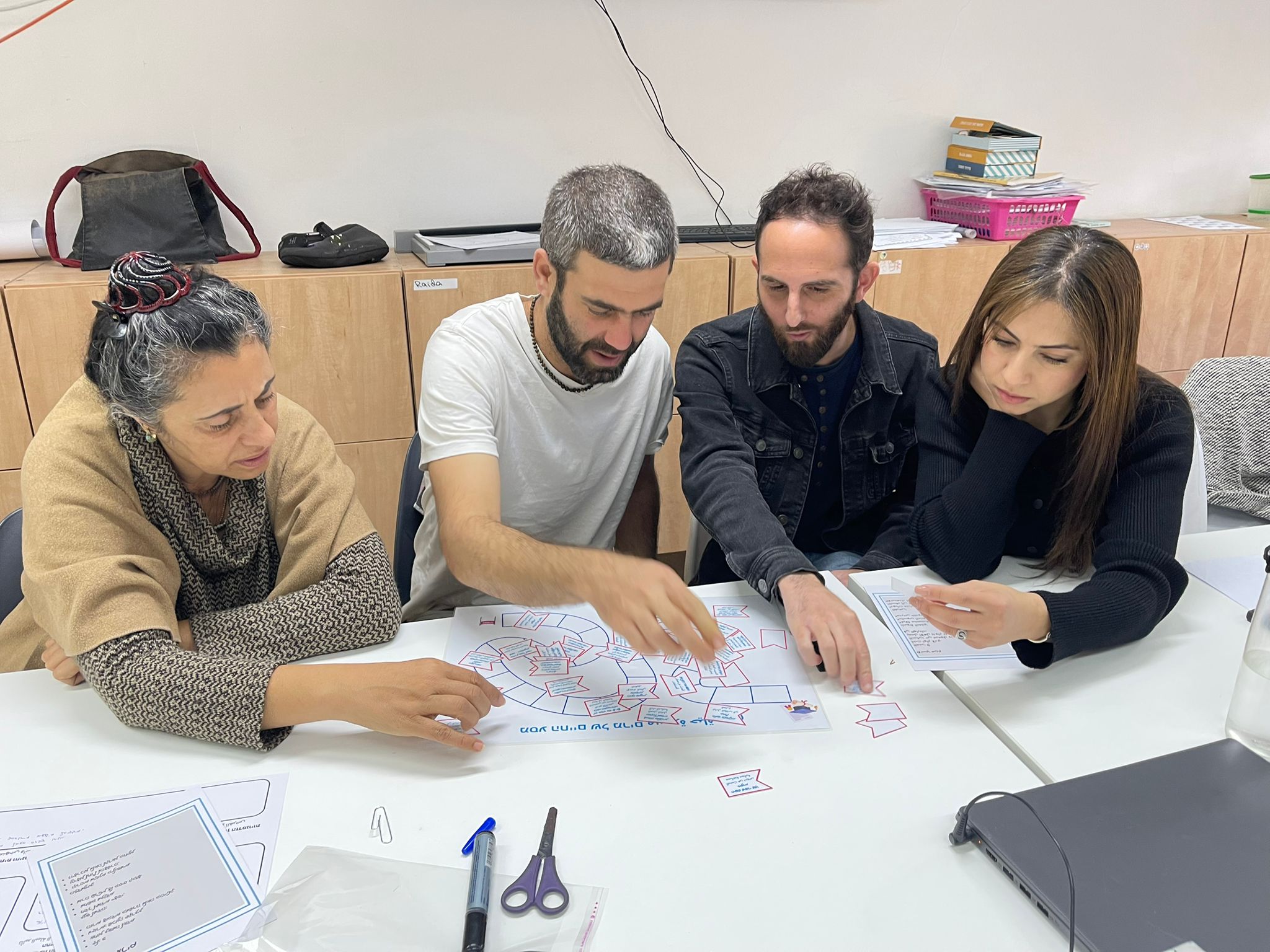
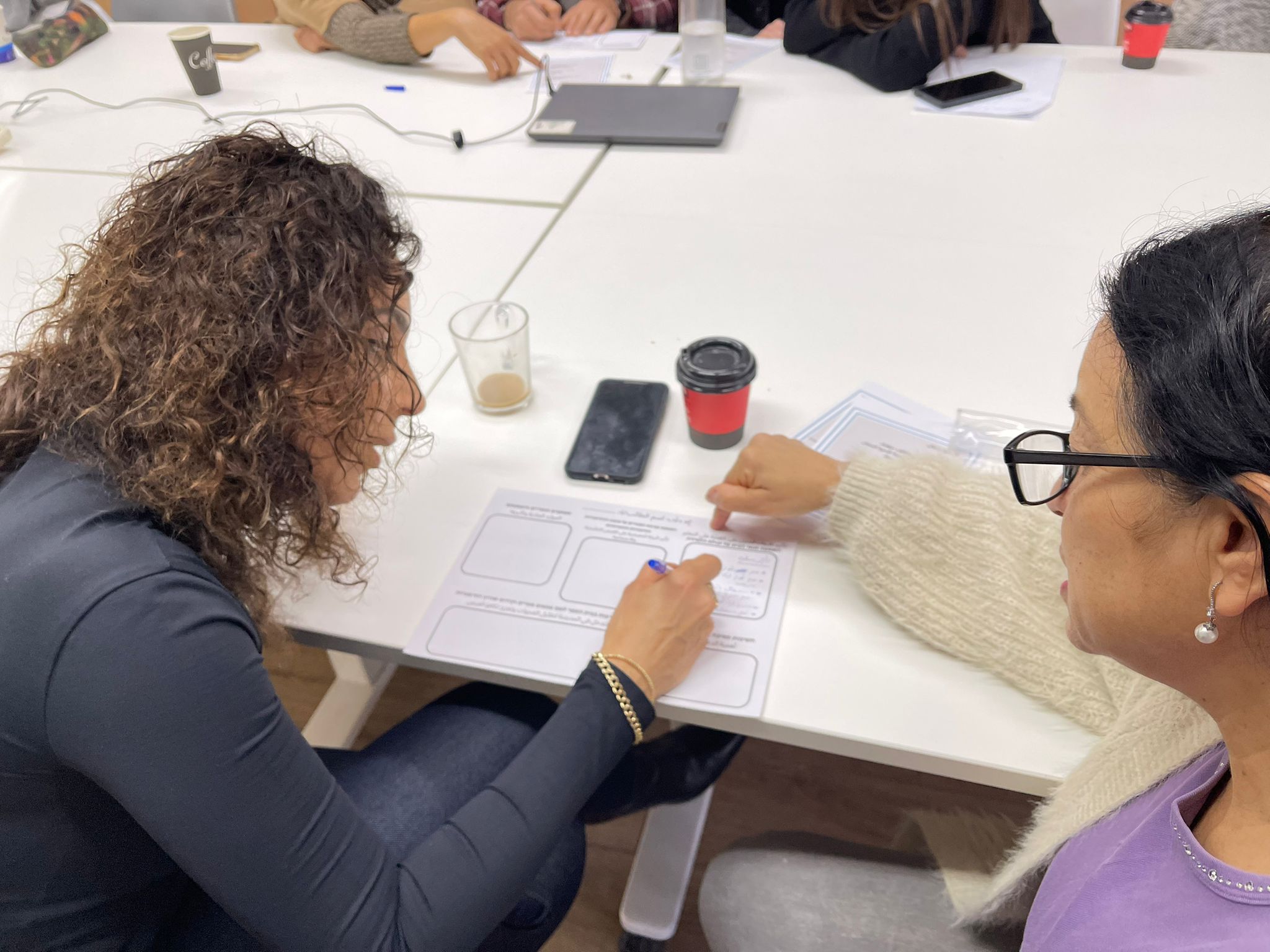
The program was facilitated by a Jewish woman and a Palestinian woman in a model of equal facilitation inspired by critical pedagogy. Through facilitated, non-hierarchical dialogue, the facilitators sought to create a complex group experience engaging questions of identity, belonging, pain, power, fear, and hope.
The training was designed as a binational dialogical space based on the School for Peace approach (Halabi & Sonnenschein, 2000), which emphasizes dialogue between two national groups living within an unequal and conflictual reality. This approach explicitly recognizes the Jewish-Zionist collective as a group with substantial power, which can also be oppressive. While the Palestinian collective is recognized as an oppressed indigenous group.
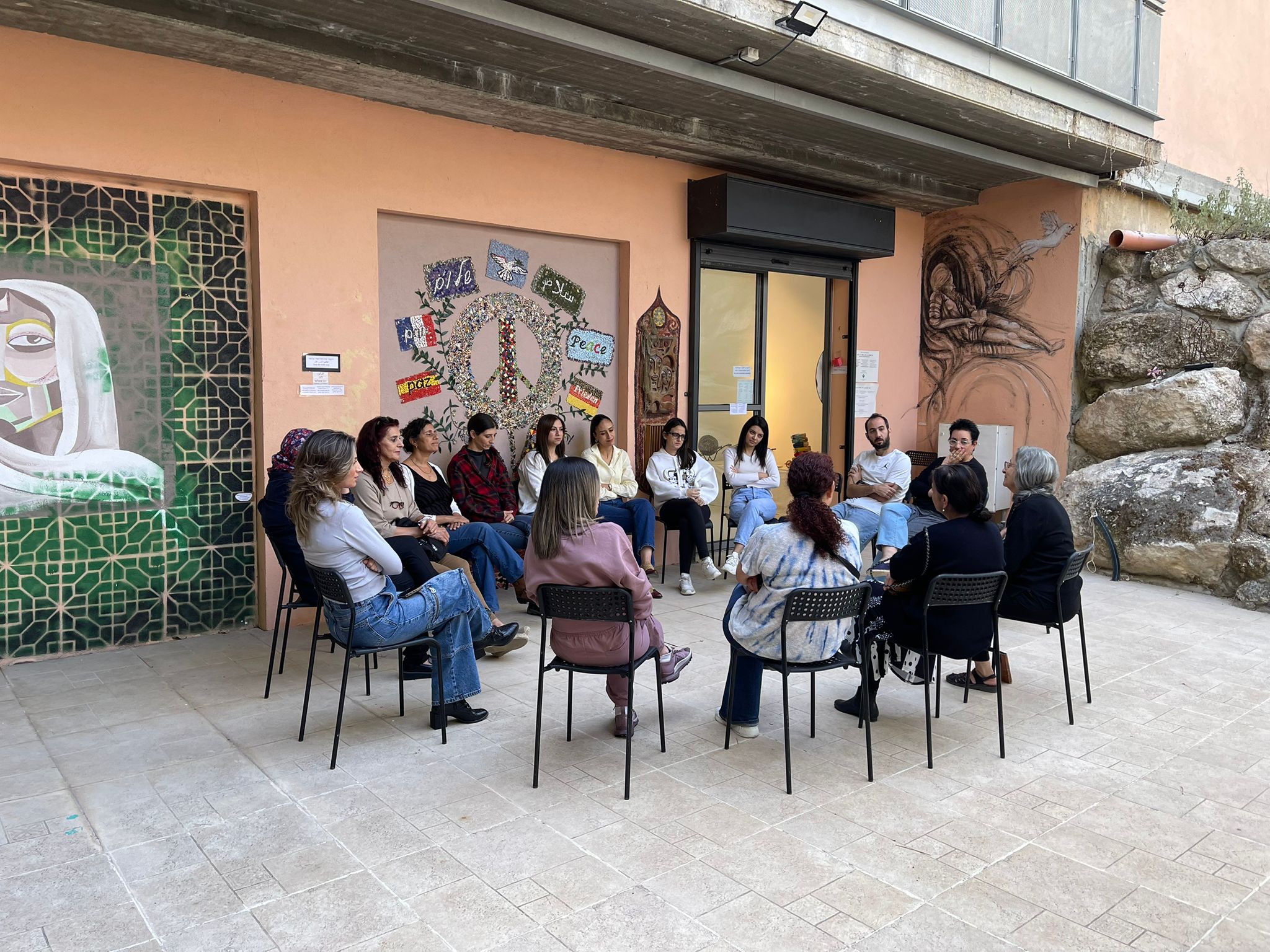
Part of the work took place in uninational groups, which enabled more authentic dialogue than the mixed groups. For example, after the outbreak of the war, the group split into uninational groups in order to discuss fears, silencing, and coping in classrooms and in the teachers’ room. Teachers spoke about the difficulty of responding to students who make harsh statements, and of dealing with attitudes of colleagues from the other national group.
Ultimately, however, most of the dialogue took place within the binational group – both because the staff had extensive experience working together and because the very division into uninational groups added to their fears of disintegration.
Already at the beginning of the war, gaps within the staff became evident. On the one hand, the team was deeply mobilized, motivated by a sense of mission and commitment to sustaining educational partnership. On the other hand, sharp differences emerged between national, social, and emotional experiences, alongside ideological gaps, systemic constraints, and tangible threats. All these produced caution, which manifested itself in silence.
From the beginning of the war, there was little emotional availability within the staff for the needs and suffering of the other group. In this sense, the staff reflected broader dynamics within society in Israel. The teachers’ room became a charged and at times paralyzing space. Teachers described breaking down in response to students’ comments. Others reported being careful not to express their opinions in the presence of colleagues from the other national group.
Most of the training took place in Hebrew, reflecting the power relations of the broader society. Language is a central issue in the School for Peace approach: both Hebrew and Arabic are considered legitimate languages within the encounter and constitute another layer of intergroup dialogue (Zak & Halabi, 2000). Although this primary school is officially bilingual, in practice only the Palestinian teachers are fluent in both Arabic and Hebrew. Most written materials distributed were bilingual. Although there was a space for spoken Arabic, Arabic was heard mainly during the uninational meetings of the Palestinian teachers with the Palestinian facilitator.
Purpose of the Article
The purpose of this article is to describe dialogue work with the teaching staff of a binational school. We also examine the tension between the facilitators’ desire to challenge the group and to protect it. The desire to challenge the group stemmed from a facilitation approach according to which group development is tied to critical reflection on the everyday practices of Jewish and Palestinian staff members. The desire to protect the group stemmed from the war taking place at the time, which threatened the very existence of the group.
From our perspective, events occurring outside the meeting room always penetrate the group space and influence it. Therefore, facilitators must focus on coping with the tensions generated within the group by external events. In what follows, we describe the practices developed for working with groups during a period of bloody crisis.
Theoretical Background – Critical Pedagogy and Dialogical Facilitation
The theoretical framework of this article is based on the School for Peace approach (Halabi & Sonnenschein, 2000), which emphasizes dialogue between two national groups within an unequal and conflictual reality. The approach draws on peace education pedagogy, viewing dialogue as a tool for exposing political and social power relations and for developing critical consciousness. According to Bajaj (2015), this approach can be defined as critical peace education, particularly because of its recognition of collective identities, conflicting narratives, structural inequality, and historical and structural injustice.
The approach is influenced by Paulo Freire’s critical pedagogy (2022/1968), which sees learning as a space of liberation, critical consciousness development, and identity formation beyond the oppressor-oppressed dichotomy.
A central component of the School for Peace approach is the understanding of participants not merely as individuals, but as members of national groups operating within a structured hierarchy (Silberberg & Abo Ras, 2026). Accordingly, the dialogue process includes a stage of internal group dialogue within uninational meetings, followed by a binational encounter in which conflicting narratives and political truths can openly confront one another.
According to Silberberg (2019a), “the School for Peace dialogue method does not primarily seek to foster empathy or mutual understanding, but rather to develop participants’ awareness of the conflict and of their role within it, and to enable them to examine and reconstruct their identities through interactions with the other” (p. 203).
The method seeks to help participants recognize the ways in which they are implicated in, or affected by, structures of power, and to act out of broader socio-political awareness. It is based on the understanding that unequal power relations exist, in which the Jewish group enjoys structural advantage.
Halabi and Zak (2014) found that the identity of most Jewish participants in dialogue groups expanded to some extent to include Palestinians. At the same time, however, Jewish-Western feelings of cultural superiority toward Palestinian-Arab culture remained present in the dialogue and hindered deeper identity transformation. Halabi and Zak describe Palestinian participants as experiencing and perceiving the situation as colonial in nature: their voices are unheard, and they feel that most Jews do not recognize them as a national group.
As noted, part of the training took place in uninational groups because such spaces allow for more authentic dialogue – intragroup dialogue that does not necessarily involve direct confrontation and does not require constant caution (Sonnenschein & Hijazi, 2000).
The fact that this school attempts to broach the conflict is already unique. Regardless of the current war, few Israeli schools conduct critical discussions about Jewish-Palestinian relations. Mark (2020) identifies two central factors contributing to the evasion of this subject: the 2011 Nakba Law, which prohibited critical discussion and mourning on Independence Day, and the 2018 Nation-State Law, which clarified that the state belongs to the Jewish people, legitimizing discrimination on that basis. This being the case, it is no surprise that teacher training programs in Israel tend to ignore the issue of Jewish-Palestinian relations and fail to address racism (Silberberg, 2019b).
The School for Peace approach maintains a complex dialogue with the theorists Yalom and Leszcz (1970/2005), who emphasized the importance of working in the here-and-now – the group space in which participants engage directly with the feelings and relationships emerging in the present moment. According to Yalom and Leszcz, working with the participants’ experience within the group allows direct access to interpersonal patterns and fosters a sense of universality. The realization that others struggle with similar emotions constitutes a central component of group healing.
In their article on dialogue groups during the current war, Silberberg and Abo Ras (2026) emphasize the importance of creating a safe space that enables dialogue. They also discuss the profound impact of political oppression on freedom of expression, as well as Palestinians’ sense that their citizenship and belonging are constantly called into question.
Furthermore, creating a sense of safety is a necessary condition for transformative group processes. Greenlee and Karanxha (2010) found that leadership and management play a central role in shaping group dynamics, particularly in building trust, cohesion, and satisfaction among school staff teams.
Distancing
During the second year of the war, the group participated in a retreat in Cyprus. The retreat included a study day on relations between the communities on the island. Distance from the local context somewhat eased participants’ ability to discuss their own reality without immediately being drawn into defensive or accusatory dynamics.
Questions of borders, occupation, oppression, and hope were discussed throughout the retreat. The comparisons, the reflective observations, and the encounter with colleagues from Cyprus all helped participants engage more deeply with what was happening in Israel and Palestine. Distance from the familiar environment enabled a kind of closeness. Being away from home made it easier for the teachers to speak more openly, express uncertainty, and engage in disagreement. It also created space for moments of pride – for example, in the fact that the Palestinian and Jewish teaching staff had succeeded in sustaining a shared educational institution unlike anything that exists in Cyprus.
One formative moment was a tour of divided Nicosia. Crossing on foot from the Greek side to the Turkish side and back again was a powerful experience. We experienced the crossings physically: walking, standing in line, and repeatedly presenting passports.
For many of the Jewish participants, the very existence of checkpoints in the heart of a city evoked thoughts such as, “How abnormal it is to live like this.” By contrast, the Palestinian participants viewed the crossings as a familiar phenomenon and remarked: “Here they call it a ‘crossing,’ but in our case it’s a ‘checkpoint’ – with concrete walls, inspections, weapons, fear, and sometimes death. The difference in terminology reveals the difference in meaning.”
This comparison – between the relatively easy crossing in Nicosia and the checkpoints in our own region – challenged the teachers. A Jewish teacher expressed empathy for Palestinians waiting at checkpoints while she herself crossed freely. A Palestinian teacher, meanwhile, struggled to imagine a conflict that was not intensely violent. A deep discussion emerged around terminology, power relations, and hope.
The retreat embodied the tension between challenging the group and protecting it. The distance removed the group from the immediate center of the conflict, strengthened group cohesion, and allowed the facilitators to challenge the group more deeply.
Analysis of the Group Process
We propose three themes reflecting the tensions that arise in dialogical work with groups living within an asymmetrical conflict during wartime. We argue that these tensions always exist in dialogical work within shared organizations, but that war intensifies them and magnifies the challenge – particularly because of the fear of group disintegration.
Between the Personal and the Political
The first dialogue meeting, mentioned above, with the facilitators after the outbreak of the war took place on October 17, 2023, following a meeting with a Jewish psychologist and an Arab psychologist from the Ministry of Education, who provided the staff with useful tools for understanding and coping with trauma. The trauma was framed as neutral, universal, and apolitical.
The meeting with the psychologists was essential in helping the teachers process the shock they had experienced and indeed provided meaningful support. However, the psychological perspective was based on an ahistorical, individual-centered framework, different from that of the School for Peace.
The School for Peace facilitators’ entry into the process made it possible to connect the individual dimension with the collective dimension and to add a political-national context. Their role was to bring the political dimension into the teachers’ room and to create space for silenced experiences and voices.
The school administration’s decision to continue the training despite the war signaled to both staff and facilitators that alongside the therapeutic stage, there was also room for confronting the relationships between Jews and Palestinians. This movement between stages symbolizes the tension between, on the one hand, protecting and supporting the staff in the aftermath of trauma and, on the other hand, politically challenging the group.
The Things That Cannot Be Spoken About
In Arab-Jewish schools, there is an ongoing fear – sometimes explicit and sometimes implicit – that Jews (students, parents, and teachers) will become dissatisfied and leave because the Jewish group is more likely than the Palestinian group to find alternative schools attractive enough to meet their needs. This fear often leads to accommodating Jewish expectations regarding how partnership should be defined. Such dynamics create mechanisms of self-silencing, especially among Palestinian teachers, who may choose silence in order to preserve the shared space.
Jewish teachers also choose silence, though for different reasons. Their caution does not stem from fear that Jews will leave, but from unfamiliarity with genuinely equal spaces in which they cannot simply say whatever they wish, as they often can in mainstream Israeli public spaces. They understand that some of their actions or opinions may hurt others or damage relationships, and they wish to avoid doing so.
For example, Jews are accustomed to openly sharing concern for family members in the army who are fighting against Palestinians. In mainstream Israeli settings they can count on such concern to be received exclusively with empathy. In a space where such concerns may be received critically, feelings of restriction and silencing emerge which are unfamiliar to them.
Another example involves Jewish teachers avoiding certain topics out of genuine concern for preserving the team and relationships within it. One such sensitive issue was the Israeli hostages in Gaza. Jewish teachers recognized that the topic, as framed in Jewish Israeli society, was charged for Palestinians. There are almost 10,000 Palestinian prisoners and detainees in Israeli prisons. The Palestinians also have prisoners whose release they seek, yet their limited experience with political dialogue left them without the tools to open such conversations.
These silences become filled with assumptions – some accurate, others rooted in fantasy. Thus, during the Zoom meeting held at the beginning of the war, the silence of the Palestinian teachers was interpreted as agreement with the Hamas attack. In reality, they remained silent not only out of shock and fear, but as an act of refusal to cooperate in the repeated demand that they condemn the attack.
This refusal was not necessarily related to their opinions about October 7 itself, but rather to resistance against having the humanity and loyalty of Palestinian citizens of Israel put on trial. The demand for condemnation existed widely in Israeli public discourse and media and seeped into the school as well. Yet people who have worked together for many years expect that their loyalty and humanity will no longer be questioned by their colleagues.
It is important to note that these are especially difficult moments within groups, since Jews are often seeking empathy in such situations and may not realize that their demands can be experienced as loyalty tests.
Between Protecting and Challenging
After the summer break, we reconvened in November 2024, during the second year of the war. By then, public discussion increasingly included allegations of genocide in Gaza. How does one open such a meeting?
We decided to foreground the war directly and visited an art exhibition titled “Where To?” (Gallery for Art, Wahat Al-Salam Neve Shalom 2024), which dealt with the war. The staff was surprised by the decision and even expressed resistance to the visit. The title of the training that year was “How to Work with Controversial Issues at School,” and participants wished to return to some form of routine and “focus on professional questions.”
The structure we proposed for that first meeting included a preparatory discussion before the exhibition, the visit itself, a processing conversation afterward, and only then engagement with educational questions from the field. During the preparatory discussion some participants expressed fear of being exposed to difficult images. There was also concern that the visit would expose disagreements they could not bear. Some of the teachers worried that the exhibition would be one-sided, focusing only on Palestinian suffering.
In practice, the experience was positive, and participants described healing experiences in their concluding reflections at the gallery. However, when we returned to the training room and invited them to reflect on the exhibition, they did not want to speak. We respected this and moved on to the pedagogical task.
We divided the group into subgroups, each focusing on a different educational issue: national, gender, cultural, class, and interreligious questions. None of the teachers chose to work on the national dimension, and it remained untouched.
Only while writing this article did we fully realize the extent to which we had been operating under tension, weighing every step carefully. We constantly moved between the desire to challenge and the desire to protect. We knew that the teachers felt suffocated and vulnerable. We knew this was a group of thoughtful adults capable of deciding for themselves how much and what to share – and yet we worried.
When working with a binational team in its workplace, we attempt both to make space for national conflict and to strengthen teamwork and create a shared organizational culture. With the teachers, we navigated our work between the separating national identity and the unifying professional identity.
It is not easy to hold a space in which conflicting identities coexist, such as Palestinian identity and Zionist identity. Throughout the meetings, we sought to politicize the discourse within the staff and integrate it with educational dialogue. At the same time, we continually asked ourselves how far this could go. From our perspective, not speaking about the political during a time of war crimes is itself a political act – one that preserves existing power relations.
The tension between protecting and challenging produced forms of action that were partial and at times indirect – but we tried not to avoid engagement altogether. We addressed the war while also respecting the group’s caution, while the group itself marked certain boundaries.
In retrospect, the facilitators wondered whether they had given in too easily to the group’s reluctance to engage with the war on Gaza. Freire and Macedo (1995) argue that in dialogue, the facilitator’s role is to educate, not merely to follow the mood of the group. Looking back, it seems that in the tension between protecting and challenging, we instinctively and unconsciously leaned toward protecting the group. Perhaps, in order to preserve the integrity of the team, it was actually necessary to challenge it more deeply.
By March 2025, resistance was expressed less through silence and more through complaints that the facilitators had not provided enough opportunities to address the conflicts. – We interpreted this less as a complaint and more as a request.
Within the extreme reality that emerged after October 2023 and continued through the writing of this article, we remained with the question: Is it possible to contest the profoundly unequal power relations that exist in our region? And if so – how?
In practice, power relations within the group remained intact. We never forgot that the training was taking place within an institutional framework, and that the institution itself is Zionist.
Conclusion
The facilitators have extensive experience working with mixed Palestinian-Jewish groups, often during periods of violence and military escalations in Gaza. Over the years, a body of knowledge has emerged that might be described as “facilitation during crisis.”
Among the recurring and sometimes conflicting characteristics we encountered in this training were: the consolidation of the group into an “island” within a stormy sea; finding comfort and hope within the group; heightened tension; expectations that people identify completely with their own side in the conflict; demands that Palestinians condemn violence and express empathy, without parallel demands made of Jews; and caution around discussing current political events.
At the same time, the current war had unique characteristics: The initial shock was unlike anything we had previously encountered. Never before had so many Israelis been killed in a single day. Never before had so many civilians been abducted. Israel’s military response reached catastrophic dimensions. The number of Palestinians killed in Gaza was extraordinarily high, most of them civilians. Allegations of genocide emerged. The number of Palestinian detainees rose into the thousands and the destruction in Gaza became – and remains – total.
Beyond the scale of the horrors, this war continues without end in sight. The multiplicity of fronts intensifies the dangers, while surveillance and persecution of Palestinian citizens of Israel within the state have reached levels we had not previously known.
In their article on dialogue groups during the current war, Silberberg and Abo Ras (2026) emphasized the importance of creating a safe space that enables dialogue, the powerful impact of political oppression on freedom of expression, and Palestinians’ sense that their civic status within Israel is under suspicion.
We would add that the dehumanization of Palestinians has long characterized Palestinian-Jewish relations. All of these dynamics shaped the group process within the training: the movement from shock to grief, expressions of fear and suspicion, the desire to preserve existing friendships, and avoidance of discussing the war.
Recognizing the centrality of the tension between protecting and challenging, we wish to emphasize the importance of preserving the group as safe a space as possible. At the School for Peace, we believe that political, social, and emotional realities do not remain outside the room. They penetrate it, remain constantly present, and shape group dynamics. This is a central principle of our facilitation approach: understanding the group as a microcosm of intergroup relations in society.
This principle aligns with the approaches of Kurt Lewin (1947) and Wilfred Bion (2003). It differs from therapeutic models that seek to leave identities outside the room and gather participants under a universal human identity.
According to our approach, national, gender, class, and cultural identities are not background noise, but essential raw materials for educational and political work in and with the group. This article suggests that external power relations are always present and must be addressed within the group rather than avoided or denied.
Although one of the foundations of group work is attention to the here-and-now, it is impossible to ignore the historical and wartime context. The universal is not neutral; it is embedded within histories of power relations. The silence of a Palestinian participant is not equivalent to the silence of a Jewish participant. The group’s here-and-now must remain conscious of the “there-and-then” of political reality, otherwise it risks becoming a mechanism of silencing.
We suggest that reflective group work can only fully take place when the social context is recognized as part of the group dynamic, similar to the proposal of De-Malach and Beeri Ben-Yishai (2009), who call for integrating interpersonal and intergroup perspectives.
In this training, the facilitators did not need to bring reality into the room. Reality knocked on the door, and when unanswered it burst in through the windows. The same is true in the school where the teachers work: the windows are open, and the daily task of the staff is to ensure that they do not become shattered.
We believe that the work with this Palestinian-Jewish staff, during these extraordinarily difficult years, enriched their cooperation by developing a discourse that enables them to recognize and tackle the reality in which they must work.
References
Bajaj, M. (2015). “Pedagogies of resistance” and critical peace education praxis. Journal of Peace Education, 12(2), 154–166. https://doi.org/10.1080/17400201.2014.991914
Bion, W. R. (2003). Experiences in groups: And other papers. Routledge.
De-Malach, D., & Be’eri Ben-Yishai, A. (2009). The group is personal and political: Integrating learning from group processes with learning about society in the spirit of critical pedagogy [Ha-kvutzati hu ishi u-politi: Shiluv lemida mi-tahalichim kvutzatiyim im lemida al ha-chevra be-ruach ha-pedagogya ha-bikortit]. Mikbatz: The Israeli Journal of Group Psychotherapy, 14(1), 49–66. (In Hebrew)
Fisher-Shalem, O., & Shapira, N. (2025). Education for shared life in Israel during the 7 October 2023 war. Journal of Peace Education, 22(3), 372–395. https://doi.org/10.1080/17400201.2025.2516433
Freire, P. (2022). Pedagogy of the oppressed [Pedagogya shel ha-meduka’im] (N. Sussmann, Trans.). Pardes Publishing. (Original work published 1968) (In Hebrew)
Freire, P. & Macedo, D. F. (1995). A Dialogue: Culture, language, and race. Harvard Educational Review, 65(3), 377–402.
Galeri Le-omanut. (2024). Ila ayna? Le’an? Where to? [Exhibition brochure]. Neve Shalom. (In Arabic, Hebrew, and English)
Greenlee, B. J., & Karanxha, Z. (2010). A study of group dynamics in educational leadership cohort and non-cohort groups. Journal of Research in Leadership Education, 5(11), 357–382. https://doi.org/10.1177/194277511000501101
Halabi, R., & Sonnenschein, N. (2000). Awareness, identity, and challenging reality: The work approach at the School for Peace [Tode’a, zehut ve-itgur ha-metzi’ut: Gishat ha-avoda be-veit-ha-sefer le-shalom]. In R. Halabi (Ed.), Dialogue between identities: Arab-Jewish encounters at Neve Shalom [Dialog bein zehuyot: Mifgashei aravim ve-yehudim be-Nvei Shalom] (pp. 16–27). Hakibbutz Hameuchad. (In Hebrew)
Halabi, R., & Zak, M. (2014). Narratives in conflict: A postcolonial interpretation of youth encounters between Jews and Palestinians from Israel. Dynamics of Asymmetric Conflict: Pathways Toward Terrorism and Genocide, 7(1), 57–85.
Lewin, K. (1947). Group decision and social change. Readings in social psychology, 3(1), 197-211.
Mark, B. (2020). Undermining national narratives with family stories: An oral history project in a Palestinian-Jewish School. In N. Fink, M. Furrer, & P. Gautschi (Eds.), The teaching of the history of one’s own country: International experiences in a comparative perspective (pp. 271–289). Wochen Schau Verlag.
Silberberg, R. (2019a). The philosophical challenges of critical peace education in the Palestinian-Israeli context. Ethics and Education, 14(2), 198-212. https://doi.org/10.1080/17449642.2019.1587686
Silberberg, R. (2019b). Dealing with racism in the classroom: A necessary component for teacher education in Israel. Educazione Aperta: Rivista di pedagogia critica, 6, 253–287.
Silberberg, R., & Abo Ras, N. (2026). Education for democracy and justice under fire: Integrating identity perspectives into global citizenship education in conflict settings. International Review of Education: Journal of Lifelong Learning. https://doi.org/10.1007/s11159-025-10164-3
Sonnenschein, N., & Higazi, A. (2000). The “home group”: The uni-national framework in the Jewish-Arab encounter [“Kvutzat ha-bayit”: Ha-misgeret ha-chad-le’umit ba-mifgash ha-yehudi-aravi]. In R. Halabi (Ed.), Dialogue between identities: Arab-Jewish encounters at Neve Shalom [Dialog bein zehuyot: Mifgashei aravim ve-yehudim be-Nvei Shalom] (pp. 131–150). Hakibbutz Hameuchad. (In Hebrew)
Yalom, I. D., & Leszcz, M. (2005). The theory and practice of group psychotherapy (5th ed.). Basic Books/Hachette Book Group. (Original work published 1970)
Zak, M., & Halabi, R. (2000). Language as a bridge and an obstacle [Ha-safa ke-gesher ve-che-michshol]. In R. Halabi (Ed.), Dialogue between identities: Arab-Jewish encounters at Neve Shalom [Dialog bein zehuyot: Mifgashei aravim ve-yehudim be-Nvei Shalom] (pp. 16–191). Hakibbutz Hameuchad. (In Hebrew)
__